Aether Project
Accelerating Scientific Discovery
A next-generation computational platform designed to bring advanced scientific simulation, scalable cloud computing and intelligent automation to researchers, engineers and innovators.
Logos is an attempt to find a cryptographically secure way of helping solve some of the biggest challenges of data security which have come about since the advent of the information age. Where do we draw a line between freedom of individuals and businesses to privacy and independence vs the State's need to enforce laws and exert control? How can we ensure the neutrality of any third party who must decide on where to draw the line? In the age of opensource technology, ACL's answer is to trust in the opensource community.
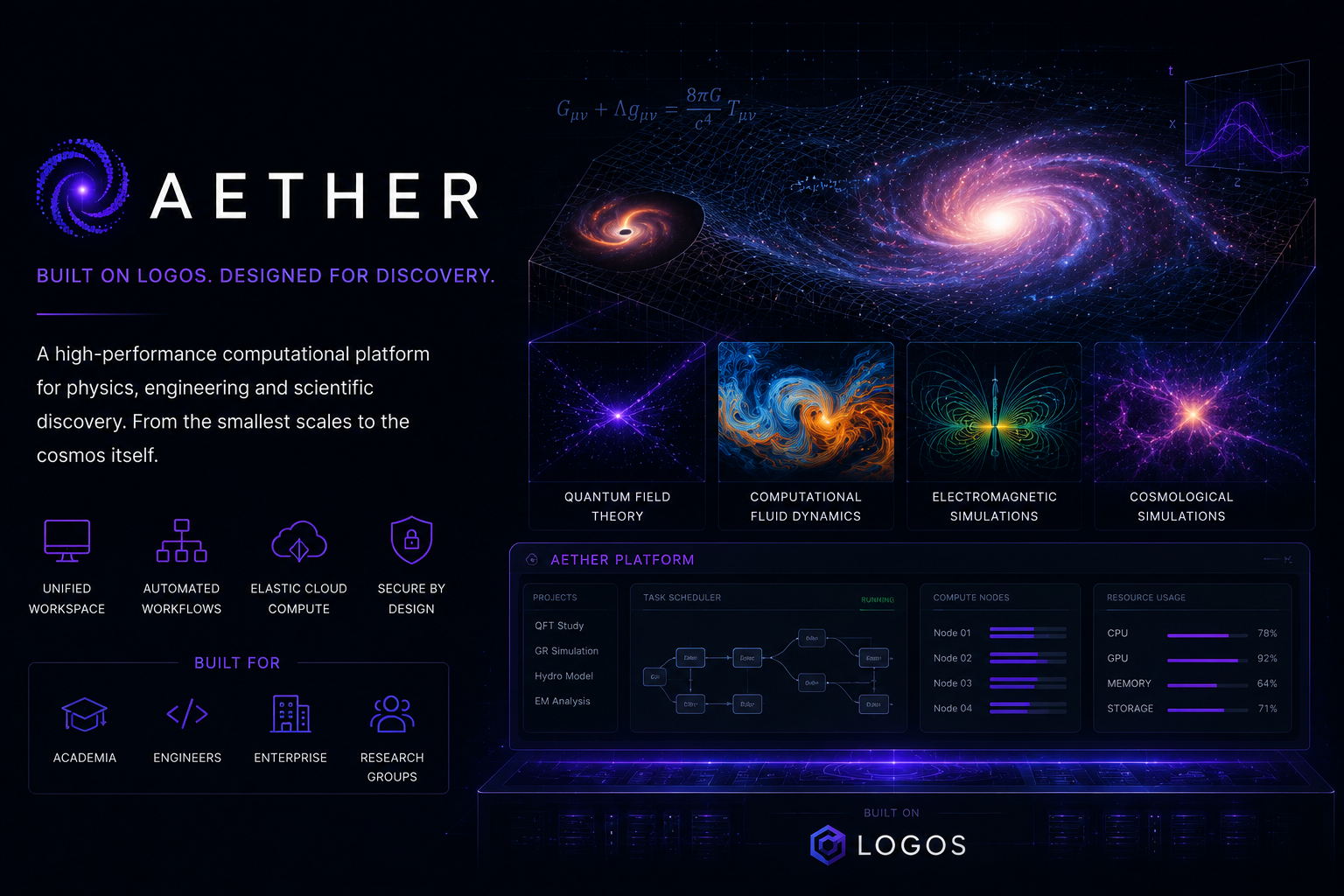
For decades, the world's most advanced simulations have been limited to universities with dedicated supercomputers, national laboratories and organisations with access to specialist computing infrastructure. Aether was created to change that. Built on the Logos platform, Aether combines modern cloud infrastructure with powerful computational tooling to make advanced numerical simulation more accessible, more scalable and significantly easier to use. Whether modelling quantum systems, analysing turbulent fluid flow, exploring new materials or investigating the evolution of spacetime, Aether provides the tools and computational resources required to transform complex research into reproducible scientific results. By combining flexible cloud computing, automated workflows and an expanding library of scientific applications, Aether aims to reduce the time between an idea and a breakthrough.
Designed for Scientific Computing
Traditional high-performance computing environments are often difficult to configure, manage and maintain. Researchers can spend valuable time preparing software environments, managing job schedulers and troubleshooting infrastructure instead of focusing on the science itself. Aether provides a modern interface for launching, monitoring and managing computational workloads across scalable cloud infrastructure. Users can submit simulations, manage datasets, automate workflows and analyse results from a single platform, allowing individuals and organisations to focus on solving scientific and engineering challenges rather than administering computing resources. From particle physics and computational fluid dynamics to thermodynamics, electromagnetics and finite-element modelling, Aether is designed to support a broad spectrum of computational disciplines while remaining flexible enough to accommodate new research domains as they emerge.
Built for Tomorrow's Discoveries
Scientific progress increasingly depends on combining multiple computational disciplines rather than treating them in isolation. The next generation of discoveries will require quantum simulations interacting with materials science, fluid dynamics informing manufacturing processes and relativistic simulations contributing to our understanding of the universe. Aether has been designed with this future in mind. As the platform evolves, it aims to integrate multiple simulation frameworks into unified computational workflows, enabling researchers to move seamlessly between different physical models while leveraging scalable cloud resources and intelligent automation. Our long-term vision is to create an ecosystem where physicists, engineers, researchers and industrial partners can collaborate on some of the world's most demanding computational problems—from designing advanced metamaterials and optimising energy systems to exploring the fundamental laws of nature.